What Is Zebra Striping? How Alternating Drinks Can Help You Drink Less
Jul 06, 2026
By Tansy Forrest, Clinical Hypnotherapist & Author of Ten Steps to Drink Less and Live Well
If you've heard people talk about “zebra striping” and found yourself quietly interested, you're probably someone who wants to drink less on a night out without turning it into an announcement. Not a dry night. Not a big conversation with everyone at the table. Just less. And still be there, still be relaxed, still be yourself.
That instinct is worth paying attention to. It's usually not about the drink itself. It's about wanting a bit more control over how the evening goes, and not quite trusting yourself to have it once the first glass is poured.
Zebra striping won't solve that on its own. But it's a genuinely useful place to start, and it's worth understanding properly: what it does, what it doesn't, and who it tends to work for.
Quick answer: what is zebra striping?
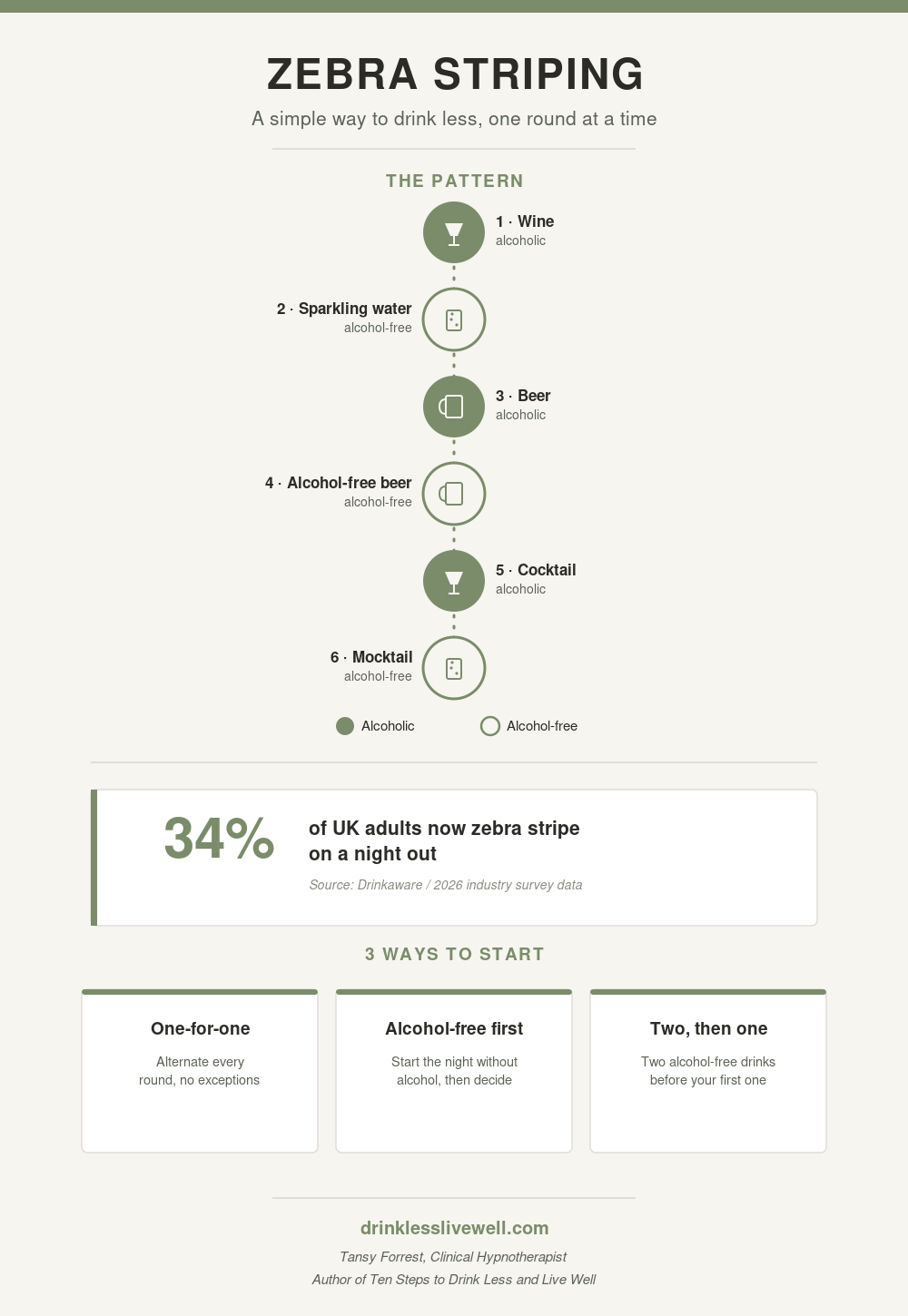
Zebra striping is the practice of alternating alcoholic drinks with non-alcoholic ones over the course of an evening. A glass of wine, then sparkling water, then another drink, then an alcohol-free beer, and so on. It can help you slow down and drink less while still feeling part of the occasion. It's a pacing tactic, not a complete solution. It doesn't address why you drink the way you do, and it doesn't guarantee you'll avoid a hangover.
A quick safety note: zebra striping is a pacing tool for social drinking. It's not designed for alcohol dependence or withdrawal. If cutting down makes you feel physically unwell, or you regularly can't stop once you start, please speak to your GP, primary care doctor, or an alcohol support service before using any self-guided drinking strategy. There's a fuller note on this further down the page.
IN THIS GUIDE
- What is zebra striping drinking?
- How to zebra stripe without making it weird
- What to say when someone offers you a drink
- Common zebra striping mistakes
- Why zebra striping can work
- Who it works best for, and what it will not do
- When zebra striping is most useful
- Does it actually reduce how much you drink?
- When zebra striping is not enough
- If you want to go further
- Frequently asked questions
What Is Zebra Striping Drinking?
The name comes from the pattern, not the animal: alcoholic, alcohol-free, alcoholic, alcohol-free, alternating like stripes through the night. The term started appearing in mainstream drinking-culture coverage in the mid-2020s, but the idea itself is much older. Alternating alcohol with water, soft drinks, or alcohol-free options is a strategy plenty of people were already using long before it had a catchy name.
It's also more common than the trend coverage might suggest. Drinkaware has found that around a quarter of drinkers are already looking for ways to cut back this way rather than stopping altogether, and separate industry surveys reported in 2026 suggest roughly a third of UK adults now zebra stripe on a night out, rising higher among 18–24 year-olds, with a similar pattern showing up among US bar and restaurant visitors. This isn't a niche habit. It's become one of the more ordinary ways people are choosing to drink less.
Part of why it's caught on now is timing. Non-alcoholic drinks have genuinely improved. The alcohol-free beers and wines available today bear little resemblance to what was around a decade ago, which makes alternating far less of a compromise than it used to be. Zebra striping has become part of a wider shift toward moderation, particularly among people who want a social night out without losing the whole of the next day to it.
None of that makes it a miracle. It's a pattern. What matters is what the pattern actually does for you, and that's worth looking at properly rather than taking the trend headlines at face value.
How to Zebra Stripe Without Making It Weird
The advice that shows up in almost every article on this topic is “decide before you go out.” That's correct, but it's also where most of them stop. Here's what actually makes it workable in practice.
- Decide your pattern before you arrive. Once you're at the bar with a drink already in your hand, willpower is doing all the work, and willpower is unreliable under social pressure. That's not a character flaw. It's just how decision-making tends to go once the moment has already arrived. A few patterns people use: one alcoholic, one alcohol-free; the first drink of the night alcohol-free; two alcohol-free before any alcohol at all; alcohol only alongside food; nothing alcoholic after 10pm; one alcoholic drink an hour, alcohol-free in between.
- Choose your alcohol-free drinks in advance. Decision fatigue is real, and “I don't know, whatever's easiest” at 8pm usually means whatever's easiest is alcohol. Have two or three go-to options ready: sparkling water or seltzer with lime, non-alcoholic or alcohol-free beer, tonic and lime, alcohol-free sparkling wine, kombucha, a zero-proof drink or proper mocktail, or soda. If you need to avoid alcohol completely, it's worth checking labels: some “non-alcoholic” drinks contain up to 0.5% ABV, while others are 0.0%.
- Make the alcohol-free drink look like a real drink. This matters more socially than it sounds. Tonic and lime in a proper glass rarely draws a comment; a visibly “soft” drink sometimes does.
- Eat before, or eat early. Zebra striping works better on a full stomach and at a slower pace generally. The two reinforce each other.
- Watch the top-up problem. A stripe disappears fast if someone keeps refilling your glass before it's empty, which is exactly what happens at a lot of dinners and weddings. Keep your own glass in view where you can, or say so plainly if someone else is doing the pouring.
- Don't use it as a driving calculation. Zebra striping is not a way to work out whether you're safe to drive. If you're driving, follow the drink-drive laws where you are and choose alcohol-free rather than counting on the pattern to keep you under a limit.
What to Say When Someone Offers You a Drink
You don't need a long explanation, and you don't need to justify anything to anyone. A short, calm line tends to land better than a paragraph of reasons:
- “I'm pacing myself tonight.”
- “I'm starting with this one.”
- “I'm alternating tonight.”
- “I've got an early start tomorrow.”
- “I'm good for now, thanks.”
- “I'm trying the alcohol-free one.”
- “I'm taking it slow tonight.”
Said once, calmly, many of these end the conversation. Repeated the same way if someone pushes, they still tend to work. You're not confessing anything. You're just stating a preference, the same way you would about food.
Common Zebra Striping Mistakes
A few things tend to undo the pattern before it's had a chance to work:
- Starting the alternation after the third drink rather than the first.
- Choosing alcohol-free drinks you don't actually enjoy, which makes the whole thing feel like a punishment rather than a swap.
- Drinking the alcoholic round faster because you feel you've “earned” it after the alcohol-free one.
- Letting other people top up your glass without noticing.
- Pairing with very sugary alcohol-free drinks that leave you feeling worse regardless.
- Using it for one night only and expecting the wider weekly pattern to shift on its own.
- Treating one good evening as proof that the whole issue is sorted.
That sugary-drinks point is worth slowing down on, because it's easy to miss. Some doctors now flag that rapid rises and falls in blood sugar, common with sugary sodas, juices, and some mocktails, can add extra strain on top of what the alcohol itself is doing, and may leave you feeling more drained the next day rather than less. Sparkling water, tonic, or unsweetened options tend to sit better across a full evening. If you do reach for something sweet, pairing it with food, or a glass of water afterwards, can help take the edge off.
The last two on that list are the ones I see most often. One good night is worth having. It just doesn't tell you much about the week it sits in, and if you've never added up an ordinary week, the alcohol units calculator takes a couple of minutes and gives you a straighter answer than memory does.
It's useful information either way. It just isn't the finish line.
Why Zebra Striping Can Work
If the practical part was all you came for, you've got it. The rest of this is why the pattern works, which is worth knowing if you ever want to adapt it rather than just follow it. Most coverage of this trend stops at “you drink less because you're drinking less alcohol overall,” which is true but not especially useful. The more interesting question is what's actually happening underneath the pattern.
It slows the first hour
The first drink tends to set the rhythm for the whole night. If it goes down fast, and the second one follows quickly behind it, the pace is often set before you've properly noticed it's happening. Putting a non-alcoholic drink in that early gap interrupts the rhythm before it forms, rather than trying to correct it later once you're three drinks in.
It keeps the ritual
A lot of people don't actually want the alcohol as much as they want a drink: something in hand, something to sip during a conversation, a small marker between one part of the evening and the next. Zebra striping keeps that ritual intact. You're not removing the thing your hand and your habits are used to reaching for. You're changing what's in the glass some of the time.
It makes the plan visible
“I'll try to drink less tonight” is a vague intention, and vague intentions are easy to lose somewhere around 9pm. “One alcoholic, one alcohol-free” is a pattern you can actually track without thinking hard about it. Plans that are specific and visible tend to survive contact with a busy bar and a good conversation. Plans that are just a general feeling usually don't.
I think of a client I wrote about in my book, Joanna, a doctor who used to pour a glass of wine most evenings to unwind after a demanding day. She didn't stop drinking altogether. She set a specific rule instead: sparkling wine on some nights, four alcohol-free days a week, and a notebook to track what she was actually drinking rather than what she assumed. It wasn't the drinking itself that changed first. It was the visibility. Once the plan was written down and specific, it was far easier to follow than a general intention to “cut back” had ever been. That's the same mechanism zebra striping runs on.
It avoids the all-or-nothing trap
This is the part that matters most, and the part most trend pieces skip. For a lot of people, the options have always felt like two extremes: drink normally, or don't drink at all. Zebra striping is neither. It lets you practise moderation in the moment, without needing to explain yourself, defend a decision, or take on a new identity for the evening. That's often the difference between a strategy someone actually uses and one they abandon by the second round.
Who Zebra Striping Works Best For, and What It Will Not Do
It tends to work well if you want to drink less without stopping completely, if you notice you drink too quickly in the first hour, if an empty hand at a party makes you restless, or if you want to stay social but feel noticeably better the next morning. It also suits people who are sober curious but not ready for a fully alcohol-free night, and anyone who wants one simple rule they can carry into parties, dinners, weddings, or work events without having to think too hard in the moment.
It's probably not enough on its own if you regularly find you can't stop once you've had the first drink, if cravings feel strong rather than mild, if you find yourself hiding how much you're drinking, if alcohol is what you reach for to cope with something difficult, or if cutting down leaves you feeling physically unwell. None of that means zebra striping was a bad idea to try. It just means the underlying pattern needs more than a pacing trick, and that's worth paying attention to rather than pushing past.
Put plainly, here is what it will not do.
- It is not a way to make heavy drinking harmless. If the overall volume stays high, alternating doesn't undo that.
- It is not a guarantee against a hangover.
- It is not a treatment for alcohol dependence, and it was never designed to be.
- It doesn't automatically solve cravings, social anxiety, boredom, stress, or the sense that a drink is how you switch off at the end of the day.
- Needing more support than a simple one-for-one rule isn't a failure. It just means the thing you're dealing with is a bit bigger than pacing.
When Zebra Striping Is Most Useful
Some situations make the pattern easier to use, and easier to stick to, than others:
- Work drinks, where staying reasonably clear-headed matters more than it would on an ordinary Friday.
- Weddings, where the event runs for hours and pacing across a long day is harder than pacing across a normal night.
- Christmas parties, where rounds and top-ups can run away from you fast.
- First dates, where nerves tend to speed up drinking without you noticing.
- Dinners, where wine gets poured at the table rather than ordered by the glass, which makes it harder to track.
- Holidays, where “just one” on day one can quietly become daily drinking by day four.
- BBQs and summer events, where drinking often starts earlier in the day, which stretches out the whole window.
Does Zebra Striping Actually Reduce How Much You Drink?
Under realistic conditions, genuine one-for-one alternation, similar-sized drinks, no faster drinking to compensate, many people will drink meaningfully less than they otherwise would. That's not nothing. It's a real, practical reduction, achieved without anyone announcing anything or sitting out the occasion.
What it can't promise is a hangover-free morning. It may reduce the likelihood or severity of one, mostly because you're probably drinking less overall and pacing more slowly across the evening. But sleep, food, how fast the evening actually went, and what got mixed with what all still matter. If the framing you've seen elsewhere is “zebra stripe and say goodbye to hangovers,” that's overselling it. This is a pacing tool, not a hangover cure.
When Zebra Striping Is Not Enough
Here's the part worth sitting with. If zebra striping works well for one night, but the wider pattern keeps returning the next week and the week after that, that's genuinely useful information. It's not a sign you did it wrong. It usually means the thing driving the drinking isn't really about pace. It might be stress. Boredom. Social anxiety. Loneliness. The way alcohol has become the way you switch off at the end of a long day, or reward yourself after a hard one.
Many people I work with come to this same realisation from a slightly different direction: they try a pacing tactic, it helps a bit, and then they notice the underlying urge is still there most evenings, tactic or no tactic. That's not a setback. It's usually the moment the real work starts: the point where you start understanding your own patterns, rather than just managing an evening.
Zebra striping sits comfortably alongside mindful drinking and being sober curious. It's a practical entry point into both, not a separate thing. If you've wondered whether any of this applies to you, grey area drinking is worth a read; a lot of people recognise themselves in it more than they expect to. And if you're looking at the bigger picture rather than just one night out, moderation strategies that actually hold up over time and the full ten-step guide to drinking less without quitting go a good deal further than any single-night tactic can.
Think of zebra striping as a good place to start, not a place to stop. It's proof that change doesn't have to be all-or-nothing, and that proof is often exactly what people need before they're ready to look at what's underneath.
A note before we go further
Everything in this article is written for people who drink more than they'd like but are not physically dependent on alcohol. Zebra striping can help with pacing on a night out, but it isn't a treatment for dependence and isn't designed to be. If cutting back causes symptoms such as anxiety, difficulty sleeping, nausea, vomiting, a racing heartbeat, sweating, shaking, confusion, hallucinations, or seizures, these can be signs of physical dependence, and stopping suddenly can be dangerous. Please speak to your GP, primary care doctor, or an alcohol support service before making changes.
This is more common than people think, and it isn't something to be ashamed of. It's a physiological state, not a character flaw, and it deserves clinical attention before anything else.
If You Want to Go Further
If zebra striping helps you for one evening, that's a win. If it also shows you that the bigger pattern needs attention, that's not failure. It's useful information, and there's no need to overhaul everything at once.
- Work out your units: two minutes with the calculator gives you a number to plan against rather than a feeling.
- The complete guide to drinking less without quitting: the whole method in one place, free, if you'd rather see how the pieces fit together before picking one.
- Read the book: Ten Steps to Drink Less and Live Well walks through this kind of pattern-recognition properly, not just for one night out but for the wider habit underneath it.
- Get the free book resources: the worksheets and hypnotherapy recordings that go alongside each chapter, at no cost.
- Join the Freedom from Overdrinking Blueprint: a step-by-step programme if you'd like more structure than a single tactic can offer.
- Book a private consultation: if you'd rather have support tailored specifically to you, this is where most of my clients begin.
For context: in a small anonymous survey of 10 past clients, respondents reported an average 65% reduction in alcohol consumption, 80% saw measurable change within one to three months, and 90% said they'd recommend the approach to a friend or colleague. This was a small client survey, not a clinical trial, but it reflects the kind of change many people are looking for once they move beyond one-night tactics. Most had tried to cut back on their own before reaching out, which tracks with everything above. Tactics like zebra striping are a genuinely good start. They're just not always the whole story.
Tansy Forrest, clinical hypnotherapist
Frequently asked questions
What is zebra striping when drinking?
It's the practice of alternating an alcoholic drink with a non-alcoholic one throughout a night out, rather than drinking alcohol back-to-back.
Is zebra striping the same as sober curious?
Not quite. Sober curious is a broader mindset of questioning your relationship with alcohol generally. Zebra striping is one practical tactic you might use within that: a specific pattern for a specific evening, not an identity or a lifestyle.
Does zebra striping actually work?
For pacing and overall volume, generally yes, as long as the alternation is genuine: similar-sized drinks, no faster drinking to compensate. It's less effective as a complete answer to why someone drinks more than they'd like, which is a separate, deeper question.
What's a good alcoholic-to-non-alcoholic ratio to start with?
One-for-one is the most common starting point and the easiest to remember. Some people prefer starting the night alcohol-free entirely, or having two alcohol-free drinks before their first alcoholic one. Whatever's easiest to actually stick to is usually the right one to start with.
Is zebra striping just Dry January rebranded?
No. Dry January is a full month off alcohol; zebra striping is an ongoing pacing pattern you can use any night, any time of year, without cutting anything out completely.
Does zebra striping prevent hangovers?
It may reduce the likelihood or severity of one, mainly because you're likely drinking less overall and pacing more slowly. It doesn't guarantee a hangover-free morning. Sleep, food, and overall volume still matter.
What should I drink when zebra striping?
Sparkling water or seltzer with lime, non-alcoholic or alcohol-free beer, tonic and lime, alcohol-free sparkling wine, kombucha, a zero-proof drink or proper mocktail, or soda all work well. The main thing is choosing something you'd actually enjoy drinking, not just the “safe” option.
Can I zebra stripe with alcohol-free beer?
Yes, and it's one of the most popular choices. Worth noting: in some markets, “alcohol-free” or “non-alcoholic” beer can still contain up to 0.5% ABV rather than 0.0%. Worth checking the label if you're avoiding alcohol completely, pregnant, or in recovery.
Is zebra striping good for grey area drinking?
It can be a genuinely useful first step if you recognise yourself in grey area drinking: drinking more than you'd like without it looking like a crisis from the outside. It won't address everything, but it's a reasonable, low-pressure place to begin.
What if I still drink too much even when I try zebra striping?
That doesn't mean you've failed. It means the issue is probably deeper than pace. It's worth looking at what's underneath: triggers, cravings, social pressure, stress, or the role alcohol plays in helping you switch off.
Sources and further reading
- Drinkaware: What is zebra striping and why is it becoming popular?
- Washington Times: 'Zebra striping' gains popularity as American consumers rethink drink
- The Food Institute: Zebra Striping, Gen Z's Strategy for Moderating Alcohol Intake
- UNILAD Tech: Doctor warns of side effect of the 'zebra striping' drinking trend
- NHS: Alcohol-use disorder, symptoms and withdrawal
- NIAAA: Understanding Alcohol Use Disorder